
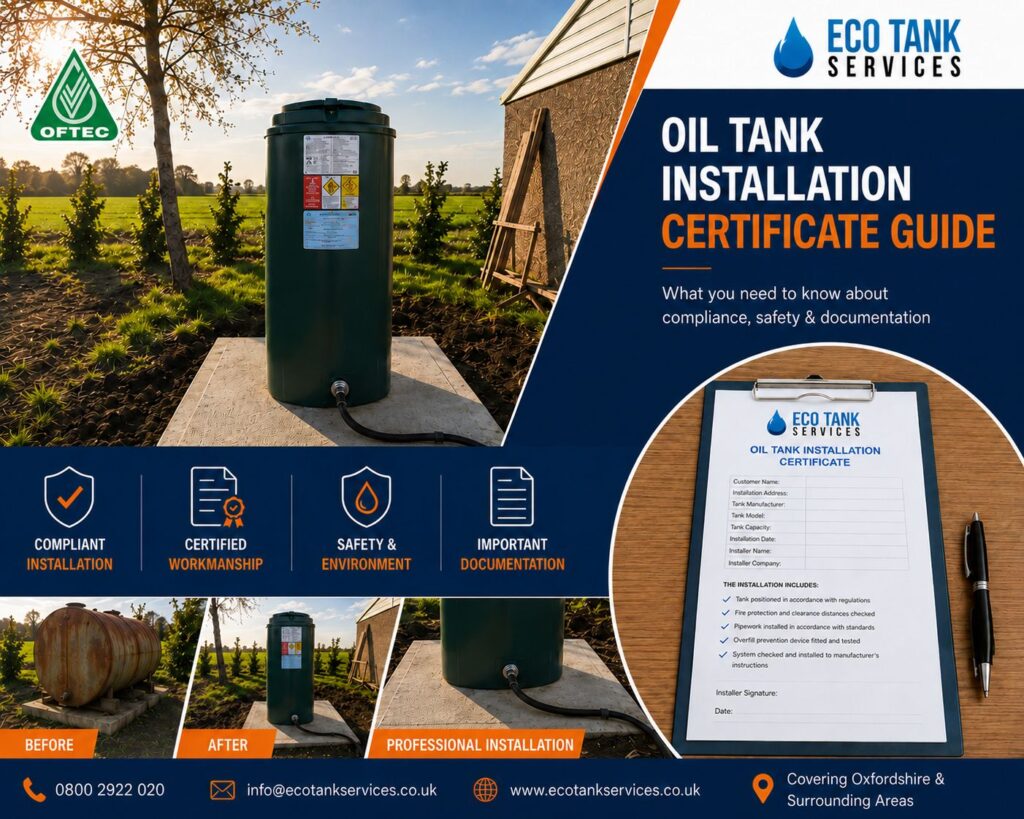
Oil Tank Installation Certificate Explained
When replacing or installing an oil storage tank, most property owners focus on the tank itself — the size, the location, the cost and the installation work.
What often gets overlooked is the documentation that proves the installation has been completed correctly.
An oil tank installation certificate is one of the most important parts of the process. It provides evidence that the installation has been carried out professionally, that safety considerations have been assessed, and that the system can be properly evidenced in the future if questions arise from insurers, surveyors, buyers, landlords or regulatory bodies.
At Eco Tank Services, we regularly work with both domestic and commercial clients who only realise the importance of installation paperwork when a property sale, insurance query or tank failure suddenly brings the issue to the surface.
In many cases, the problem is not simply replacing an old tank. It is ensuring the installation is compliant, correctly positioned, environmentally safe and fully documented.
What Is an Oil Tank Installation Certificate?
An oil tank installation certificate is a formal document issued following the installation or replacement of an oil storage tank.
The certificate records key details relating to the installation and demonstrates that the work has been completed in accordance with relevant standards, installation requirements and applicable regulations.
Depending on the project, the documentation may include
- Tank type and capacity
- Installation date
- Site address and location details
- Installer or competent contractor information
- Pipework and connection details
- Safety and commissioning checks
- Fire separation distances
- Spill protection and environmental measures
The exact format can vary depending on whether the installation is domestic or commercial.
Domestic heating oil systems are commonly linked to competent person schemes and building regulation notification processes, while commercial installations may require broader commissioning records, environmental documentation and site-specific compliance reporting.
This distinction is important because there is no single “one-size-fits-all” oil tank certificate used for every installation.
Learn more about our installation services:
https://ecotankservices.co.uk/services/oil-tank-installation
Why an Oil Tank Installation Certificate Matters?
An installation certificate is not simply paperwork for filing away.
It provides traceable evidence that the installation was assessed and completed properly at the time of the work.
That becomes extremely important in situations involving:
- Property sales
- Insurance renewals or claims
- Landlord responsibilities
- Environmental incidents
- Commercial compliance audits
- Future tank replacement or servicing
If an oil leak, fire or contamination issue ever occurs, insurers may request evidence of:
- When the tank was installed
- Who carried out the installation
- Whether fire protection distances were followed
- Whether secondary containment was required
- Whether the installation met accepted standards
Without documentation, proving compliance can become difficult and costly.
Oil Tank Certificates and Property Sales
One of the most common situations where installation paperwork becomes important is during a property transaction.
Surveyors and buyers increasingly ask questions about:
- The age of the oil tank
- Installation compliance
- Environmental risk
- Previous leaks or contamination
Where no documentation exists, uncertainty is created.
That uncertainty often results in:
- Delays in the sale process
- Additional inspections
- Requests for specialist reports
- Concerns from insurers or mortgage providers
A properly documented installation provides reassurance and reduces future complications.
What Should an Oil Tank Installation Certificate Include?
A professional installation record should demonstrate far more than the simple fitting of a new tank.
It should confirm that the wider installation was assessed for safety, environmental protection and operational suitability.
Key areas commonly covered include:
- Tank siting and positioning
- Base construction and support
- Pipework routing and protection
- Isolation valves and safety controls
- Overfill prevention measures
- Fire protection clearances
- Environmental spill protection
- System commissioning checks
On more complex projects, supporting documentation may also include:
- Site assessments
- Photographic installation records
- Tank decommissioning documentation
- Waste transfer records
- Compliance reports
This is particularly important where older tanks are being removed, contamination risks exist or significant redesign work is involved.
Related service:
https://ecotankservices.co.uk/services/oil-tank-removal/
Who Issues an Oil Tank Installation Certificate?
The certificate should be issued by the competent contractor responsible for carrying out the installation.
For domestic systems, this may involve installers operating under recognised competent person schemes linked to heating oil installations and building regulations.
Commercial projects may involve additional commissioning records and compliance documentation depending on the site and storage requirements.
However, the most important factor is not simply the existence of a certificate — it is the competence and accountability of the installer behind it.
Oil storage systems involve:
- Fire risk
- Environmental pollution risk
- Fuel contamination risk
- Regulatory responsibilities
A qualified contractor must assess the entire installation, not simply position a new tank and connect pipework.
At Eco Tank Services, every installation project is approached with a focus on:
- Compliance
- Safety
- Environmental protection
- Long-term system reliability
When Do You Need an Oil Tank Installation Certificate?
You should expect installation documentation whenever:
- A new oil tank is installed
- An old tank is replaced
- Major alterations are made to the fuel storage system
- Commercial oil storage infrastructure is upgraded
For many domestic properties, this happens when an ageing or damaged tank is replaced with a modern bunded system.
Commercial installations are often driven by:
- Planned asset replacement
- Environmental risk reduction
- Compliance upgrades
- Site redevelopment projects
What If Your Existing Tank Has No Paperwork?
This is extremely common with older installations. In many cases, tanks installed years ago may have limited or no documentation available. While a genuine retrospective installation certificate cannot normally be created after the fact, a professional inspection can still provide valuable information.
A condition assessment may help identify:
- Compliance concerns
- Safety risks
- Signs of deterioration
- Environmental exposure risks
- Whether replacement is advisable
Book an inspection with Eco Tank Services:
https://ecotankservices.co.uk/contact/
Oil Tank Installation Compliance in the UK
Oil tank compliance requirements vary depending on:
- Domestic or commercial use
- Tank capacity
- Proximity to drains or watercourses
- Ground conditions
- Environmental sensitivity of the site
A simple domestic replacement installation may involve very different requirements compared to a commercial fuel storage system. This is why professional site assessment matters. Two tanks may appear similar visually while requiring completely different safety and environmental protection measures. A professional installation certificate should reflect the actual site-specific assessment carried out during the project.
Common Problems When Installation Records Are Missing
The most common issue is delay. Missing paperwork frequently creates complications during:
- Property sales
- Insurance renewals
- Commercial audits
- Future maintenance planning
The second issue is cost. Without evidence of installation standards, owners may need to commission additional inspections or remedial works. The final issue is liability. Where no documentation exists, the current owner or operator often carries the burden of uncertainty surrounding the installation.
Choosing the Right Oil Tank Installation Contractor
If you are replacing an oil tank, discuss documentation before the installation begins — not after the work is complete.
A professional contractor should clearly explain:
- What certification will be provided
- Whether building control notification is required
- What records should be retained
- What compliance considerations apply to the site
The installation process should also include assessment of:
- The tank base
- Pipework condition
- Filters and valves
- Environmental risks
- Safe decommissioning of the old tank
A proper installation is about far more than fitting a new tank. It is about ensuring the entire system is safe, compliant and professionally documented for the future.
At Eco Tank Services, we approach every installation project with that complete long-term view in mind.
Contact Eco Tank Services
Frequently Asked Questions
Do I need a certificate for a new oil tank installation?
Yes. A professional installation should always include appropriate documentation confirming the work completed and relevant compliance considerations.
Can I sell a property without an oil tank installation certificate?
Yes, but missing paperwork can create delays, additional surveys or concerns from buyers and insurers.
Who provides an oil tank installation certificate?
The competent contractor responsible for the installation should issue the relevant documentation.
What happens if my oil tank has no paperwork?
A professional inspection or condition assessment can help establish the current condition and identify any compliance concerns.
Does an oil tank installation certificate guarantee future compliance?
No. The certificate demonstrates that the installation was completed in line with relevant standards at the time of installation. Ongoing maintenance and inspections remain important.